Sunday, August 11, 2013

Cats in Art: Painted Desert Lion (Unknown Prehistoric Artist)

From my continuing weekly Sunday series of cats in art. Currently I'm using some prehistoric art, triggered by finally seeing "Cave of Forgotten Dreams" which depicts 30,000 year old art in Chauvet Cave, France.
 
Image credit The Big Cats in Rock Art, here
 
 
The Classic Cat, from the Painted Desert in Arizona.  No info on size or technique.
 
I figured I'd keep on with the notion of cats in prehistoric rock art, but the pickings are surprisingly slim.  Google Images has been helpful, but I believe that if I had access to an in-depth art library--think major university--I could likely find plenty of rock art kitties.
 
This cat is so stylized as to be a bit frightening.  The claws are highly emphasized and the mouth is downright scary.  It seems apparent that the artist was a bit wary of the mountain lion (also locally called cougar or panther).


Friday, August 9, 2013

Perseid Meteor Shower: Time for a Night Run Sunday or Monday

Well, it's August and again our planet has (literally) made another circle and is soon to intercept the cloud of galactic dust and crud that will produce the annual Perseid Meteor shower when the Earth passes through it.

So...here in the northeast, the 2 prime nights are Sunday into Monday and Monday into Tuesday.

Here's what Astronomy.com has to say about it:


If you ask most skygazers to name their favorite meteor shower, the odds are good that “Perseid” will be the first word out of their mouths. This annual shower seemingly has it all: It offers a consistently high rate of meteors year after year; it produces a higher percentage of bright ones than most other showers; it occurs in August when many people take summer vacation; and it happens at a time when nice weather and reasonable nighttime temperatures are common north of the equator. No other major shower can boast all four of these attributes.

And this year’s Perseid meteor shower promises one other significant advantage: It peaks under a Moon-free sky. From mid-northern latitudes, the waxing crescent Moon sets shortly after 10 p.m. local daylight time on the 11th. As always, you’ll see more meteors at a viewing site far from artificial lights.
 
If predictions hold viewers in North America should see up to 80 meteors per hour — still an average of more than one per minute — in the hour or two before twilight starts to break shortly after 4 a.m. local daylight time. If cloudy skies prevail on the 12th, look on the morning of the 13th, when rates will be somewhat lower but still impressive.

And from the same site, here's where to look in the sky.  That's Polaris--AKA the North Star--hanging at the 10:00 position.  So your general viewing orientation should be facing northeast.  The caption "Radiant" there in the center simply refers to the approximate location from which the meteors will appear to radiate from:


I have NEVER yet done this--but I am reminded that at my age there are only so many summers remaining to me--but I am sorely tempted to set my alarm for, say 2:00 am early Monday morning (provided it's clear) and go for a run. 
 
It could be magical, and who doesn't need a touch more magic in their lives?


Thursday, August 8, 2013

Feel Safer Now (NSA Stuff)?

From our pal, the Earth Bound Misfit (on 2 Aug, link here), a quantification of the terror-disrupting benefits of all that illegal NSA spying:

So, How Many Terrorist Plots Been Disrupted Because the NSA has Been Collecting the Phone Records of All Americans For the Past Dozen Years?

You might recall that the NSA has claimed to have disrupted 54 terrorist plots or "dozens."
.

 
Well, NSA deputy director John Inglis revised that number at a Senate hearing two days ago all the way down to one plot, maybe.

Really. Thousands of NSA analysts, Lord knows how many contractors are sucking at that particular teat, they are building a new server farm the size of Rhode Island and all they can show for that effort is that they uncovered one plot?

Feel safer now?
 

Wednesday, August 7, 2013

Trail Work: Reese Hollow Trail

Couple days ago I did some recurring trail maintenance work on "my" trail.  The Reese Hollow Trail is a side trail in southern PA that links the dry, ridgetop Tuscarora Trail with a shelter and spring.

The weeds are bad this year and I used my gas weed whacker to keep the trail open and the weeds to a manageable height.


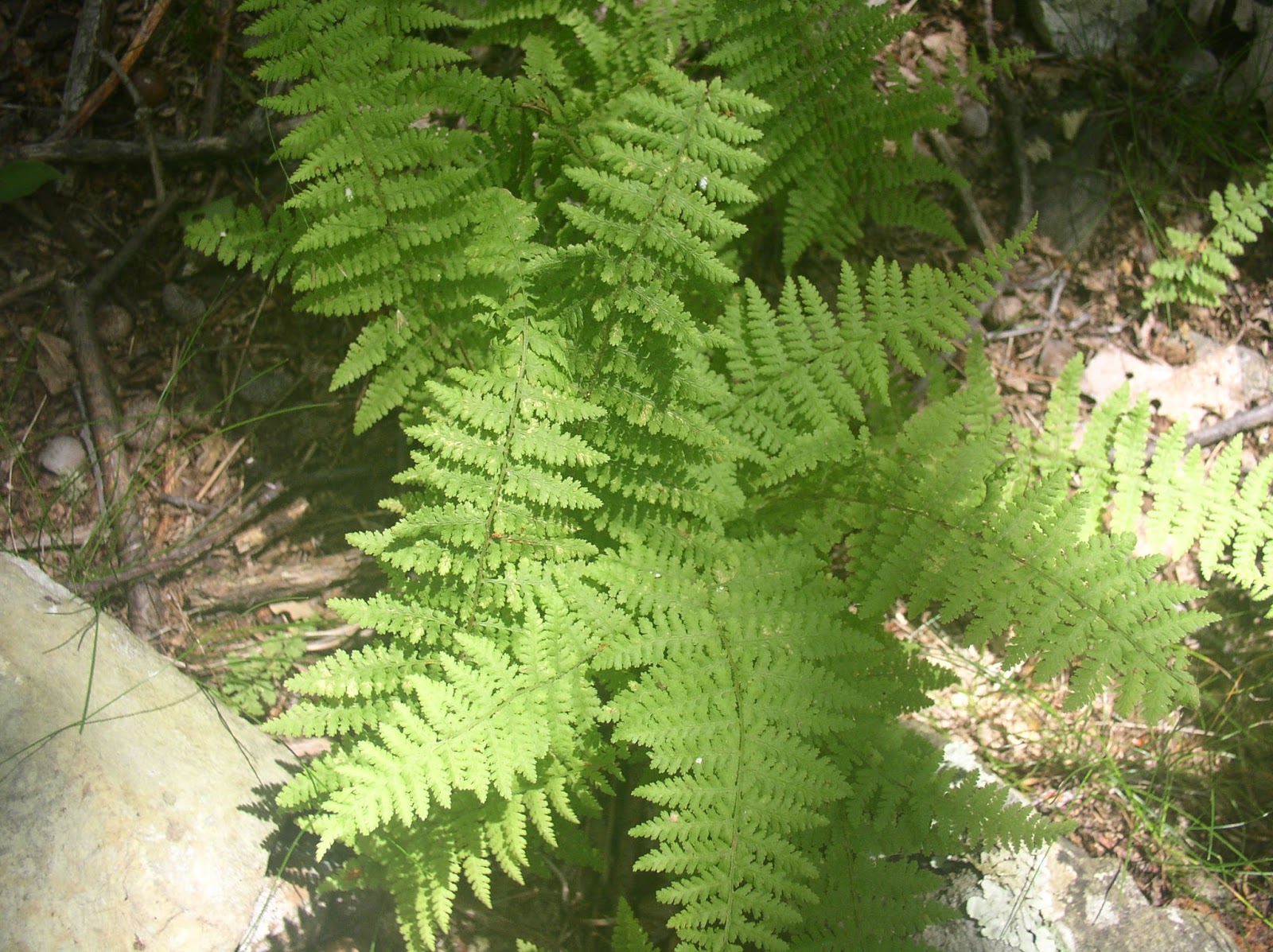
I use the term "weeds" rather loosely, becasue I never would have imagined that I would have to weed whack ferns. Turns out that ferns are ubiquitous in this area and in places would totally encroach and cover the trail.


[image credits Gary]


I used up 3 tanks of gas, and was about shaken to pieces from the chronic vibration.  Note to self: next time don't leave the goggles and hearing proection in the garage.  I also cleared 2 minor blowdowns.

I also mounted a couple of signs I made.  I don't have a router so I used a Dremel tool to cut the letters. Mine is the lower yellow sign to provide spring and distance info.


Hikers should note that Tuscarora Trail is again VERY overgrown this summer with briars (actually I think they are wild raspberries). There are some quite negative comments in the trail register on the TT near top of Reese Hollow Trail.

This ridgetop is pretty clear (many trees gone, perhaps due to gypsy moths) so that a ton of sunlight reaches the forest floor, promoting a lush growth of understory...including the briars.

Frankly, I cannot recommend hiking the southern PA section of the Tuscarora Trail (south of PA RT 16) right now unless you wear jeans and long sleeves; you will get badly scratched up.

I tried an experiment last month on a 200-yard stretch of the Tuscarora Trail just north of its junction with my Reese Hollow Trail.  Rather than clip or cut the briars since they are very shallow-rooted, I simply pulled the briars out by their roots using thick leather gloves.

That 200 yard stretch of trail remains clear enough to hike easily: grassy but the briars are still at bay off to the sides of the trail.  However, it'd take a big crew of people to cover a dozen miles using this technique.


Tuesday, August 6, 2013

Advice When Visiting a Sick/Injured Ultrarunner

Somehow on the net I wound up on this site where I read some great advice called The Ring Theory, on how you should react to a person with some crisis.  It works for all kinds of crises: medical, legal, financial, romantic, even existential.


Draw a circle. This is the center ring. In it, put the name of the person at the center of the current trauma. Now draw a larger circle around the first one. In that ring put the name of the person next closest to the trauma. Repeat the process as many times as you need to. In each larger ring put the next closest people. Parents and children before more distant relatives. Intimate friends in smaller rings, less intimate friends in larger ones. When you are done you have a Kvetching Order.
Here are the rules. The person in the center ring can say anything she wants to anyone, anywhere. She can kvetch and complain and whine and moan and curse the heavens and say, "Life is unfair" and "Why me?" That's the one payoff for being in the center ring.
Everyone else can say those things too, but only to people in larger rings.
When you are talking to a person in a ring smaller than yours, someone closer to the center of the crisis, the goal is to help. Listening is often more helpful than talking. But if you're going to open your mouth, ask yourself if what you are about to say is likely to provide comfort and support. If it isn't, don't say it. Don't, for example, give advice. People who are suffering from trauma don't need advice. They need comfort and support. So say, "I'm sorry" or "This must really be hard for you" or "Can I bring you a pot roast?" Don't say, "You should hear what happened to me" or "Here's what I would do if I were you." And don't say, "This is really bringing me down."

I needed this advice recently in talking to a friend, an Ultrarunner who could no longer run (back problems combined with an endocrinogical type disease).  Thankfully, without knowing about The Ring Theory I was able to do the right  thing anyway.

I asked him about missing trail running and he talked about that loss, and how he hoped he'd still be able to do some walking to get some woodsy time.  I didn't tell him about my latest backcountry adventure or anything like that until he asked, and then I kept it short and factual until he probed further.  Then I offered more detail.

So, go check out The Ring Theory.


Sunday, August 4, 2013

Cats in Art: Panther Panel (Unknown Prehistoric Artist)

From my continuing weekly Sunday series of cats in art. Currently I'm using some prehistoric art, triggered by finally seeing "Cave of Forgotten Dreams" which depicts 30,000 year old art in Chauvet Cave, France.


Image credit The Bradshaw Foundation, here

Medium: red pigment on rock, 5 m x 1.5 m, approximately 30,000 years ago, unknown artist

Ten drawings are arranged over the area. The animal figures include 3 bears, 2 felines - including a panther - 2 ibex, 3 unidentifiable animals and 1 red dot, made with the palm of the hand. The central piece of the panel is dominated by the panther and the 2 superimposed bears. Whilst the outlines are precise and 'essential', the figures are incomplete. The spots on the panther represent a feline coat, where as the spots on the cave bear probably suggested a thicker fur. The figures are all drawn in red. Other visible marks on the panel are attributable to bears - paw-rubs and claw marks.

The cats in the image probably are Owen's Panther (Puma pardoides), a poorly known Old World fossil representative of a large cougar-like cat of Eurasia's Pleistocene (reference here).

As in last week's post of the lions in Chauvet Cave, I marvel at the artist who actually saw these panthers and had the artistic skills to draw them.  One can't help but ponder the timeless qualities of art and beauty intertwined...that's some enduring art, right there.


Friday, August 2, 2013

Gary's Relationship Advice

Yesterday's post about the wisdom of old female elephants got me to thinking about relationships. Nothing to do with Ultrarunning here.

This whole age/experience thing kinda dovetails with my theory of relationships. In today's culture young lovers often take things to the next level way too fast: dating, sex, moving in together, marriage (or not).

I've always thought that the key ingredient that seems to be missing is time: you need to be with someone for months, not weeks, so you can see them at their best and at their worst, in sickness and in health, so to speak, before you commit.  You need to see them when they are up, when they are down, how they handle pressure and adversity and joy and sorrow...before you are inextricably linked.

You don't want to be learning your loved one's basic traits after you've pulled the commitment trigger, because you may not like what you see.

Which brings me back to the value of just spending time, unrushed, unhurried time.  If your loved one holds up well (i.e., is a decent human being under most circumstances), then you may know that he or she is the one.


Thursday, August 1, 2013

Age and Experience DO Count...and Ultrarunning

Via Science Magazine, here, confirmation from the animal kingdom of what is generally also true among humans: age and experience DO count:

What good is an older female elephant to her herd, especially one in her 60s and well-beyond her prime reproductive years? She's the best leader and the one most capable of making wise decisions, according to a study of African elephants (Loxodonta africana) in Kenya's Amboseli National Park that was published today in the Proceedings of the Royal Society B. The oldest female in an elephant herd is always the leader.

But how did the researchers demonstrate this quantitatively, since this topic is mighty subjective?  A pretty ingenious experiment:

Researchers tested the decision-making skills of these matriarchs by playing recordings of lions roaring; they monitored the elephants' reactions to the roars of a single lion versus three lions for both male and female lions. Because of their size and heft, single male lions can pose a greater threat to elephants than do female lions. The oldest matriarchs proved best at recognizing a male lion's roar, as 66-year-old Joyce does in this video [Gary note: go to link, here, for the video]. When she hears the three male lions, she bunches her herd in a tight phalanx to ward off a possible attack. The study provides the first experimental evidence that the members of a herd benefit from an older leader—a discovery, the researchers say, that also shows how vital it is to protect the elders (who usually have the biggest tusks) from ivory poachers.


I like to think that as I've aged as an Ultrarunner, I've also gained the experience and knowledge that only years can bring.  Although I certainly recall as a young man thinking that old people thought they knew it all.

Turns out they did (at least to a point).

In Ultrarunning I've realized that it's the journey and not the destination.  I don't do dumb things anymore (usually!) such as not telling loved ones where I'll be and when I expect to get back.  Plus I always carry my cell phone on the trail , and more water and trail food than I think I'll need.

But mostly I just sorta listen to my instnincts and go with my gut in pacing, in adapting to weatehr conditions, whether, say, adding that loop makes sense today. 

My credo now--just like they told us in the 60s--is that speed kills. So take it easy and enjoy the trail.