Showing posts with label Audubon. Show all posts

Tuesday, January 6, 2015

Pathetic Mermaid

I had planned on heading over to "my" Reese Hollow Trail and Shelter today for some work on improving the trail from the shelter up to the privy.  The privy trail is quite obvious during the day, but for navigation in the dark, I want to edge the trail with rocks and logs to help folks remain on the path.

Certainly not a requirement; just a nice touch.

Unfortunately today we got an unexpected 4" of snow, when only a dusting was called for.  Since the trail and the planned building materials (rocks, logs) are buried, I waved off today's trip and will try next week.  In the meanwhile, I took some photos around my place here in south-central PA.  I LOVE snow photography! (all images credit Gary)

The mermaid is a cast iron statue, maybe 30” from flippers to head.  She’s bent in the middle so she sits, and all summer she enjoys her perch beside the waterfall at the water garden…but come winter, she pays the price!


The snowman gourd is one we grew and then painted.  It’s about 10” tall.  He obviously likes the snow better than the mermaid does.


Lastly is the view out our bedroom window to our bird feeding station.  On the left is the Audubon birdcam pointed at a block of suet on the post in the middle.  The sunflower seed feeder is to the right inside the wrought iron hemispherical piece.


I've been experimenting with the automatic birdcam to ascertain exactly where the sweet spot is on focal distance to get an absolutely clear and sharp image.  I'll run the camera  for a few days, view the photos, move it an inch in or out, then try again.  I'm planning to do a post soon with the best images.


Sunday, October 20, 2013

Cats in Art: A Pair of Cougars (Audubon)

From my continuing weekly Sunday series of cats in art. Currently I'm turning for a few weeks to John James Audubon.  I thought I was finished with Audubon, then I uncovered a 5th image to post about.


Image credit here, A Pair of Cougars, John James Audubon.

If you recall from the previous posts in the Audubon series, Audubon is much better known for his stunningly beautiful paintings of birds. Per Wikipedia, "His major work, a color-plate book entitled The Birds of America (1827–1839), is considered one of the finest ornithological works ever completed."

What many folks don't know is that Audubon also set out to depict all North American quadrupeds (primarily four-footed mammals). His three-volume The Viviparous Quadrupeds of North America, published in 1845, contained this illustration.

This pair of loving kitties is a welcome change from some of Audubon's other works--and their sometimes disturbing attributes.  These guys seem to me to almost have a whiff of Oriental art about them--they would seem equally at home in a Japanese panel. 

The cats are relaxed and happy, and as we've seen before, Audubon captures well the notions of power and grace (the usual third component, stealth, is absent in this image).

Sunday, October 6, 2013

Cats in Art: Texan Lynx (Audubon)

From my continuing weekly Sunday series of cats in art. Currently I'm turning for a few weeks to John James Audubon.


Image credit here, Texan Lynx, John James Audubon.

If you recall from the previous posts in the Audubon series, Audubon is much better known for his stunningly beautiful paintings of birds. Per Wikipedia, "His major work, a color-plate book entitled The Birds of America (1827–1839), is considered one of the finest ornithological works ever completed."

What many folks don't know is that Audubon also set out to depict all North American quadrupeds (primarily four-footed mammals). His three-volume The Viviparous Quadrupeds of North America, published in 1845, contained this illustration.

This image to me is quite odd, strange in the same sense like the one of the bobcat that introduced this 4-part series, here.  While that cat looked psychotic and demonic, this one is just focused on licking its privates.  In both cases, not a very graceful pose to adorn what was meant to be a comprehensive rendering of the animals of North America.

All in all, Audubon kinda struck out in his kitty art.

Sunday, September 29, 2013

Cats in Art: The Jaguar (Audubon)

From my continuing weekly Sunday series of cats in art. Currently I'm turning for a few weeks to John James Audubon.

 
Image credit The Philadelphia Print Shop here, The Jaguar, John James Audubon.
 
 
If you recall from the post 2 weeks ago, here, Audubon is much better known for his stunningly beautiful paintings of birds. Per Wikipedia, "His major work, a color-plate book entitled The Birds of America (1827–1839), is considered one of the finest ornithological works ever completed."
 
What many folks don't know is that Audubon also set out to depict all North American quadrupeds (primarily four-footed mammals). His three-volume The Viviparous Quadrupeds of North America, published in 1845, contained this illustration.
 
Jaguars have always held a special fascination for the bride and I.  We once spent a couple of days in Belize at a jaguar sanctuary called Cockscomb Basin, where we hiked some distance during different times of the day (morning, mid-day, late day, dusk, and at night) but without catching a glimpse of a live cat.  We had hoped to get lucky, although only about 5% of guests do see a live jaguar.
 
We did, however, see some very fresh prints:
 
 
Image credit Gary
 
 
But back to Audubon...again in this image, as I have posted on his other cats, he really captures three key elements of any wild cat: grace, power, and stealth.  This particular one especially emphasizes the power aspect of a jaguar.


Sunday, September 15, 2013

Cats in Art: Ocelot or Leopard-Cat (Audubon)

From my continuing weekly Sunday series of cats in art. Currently I'm turning for a few weeks to John James Audubon. 


Image credit The Philadelphia Print Shop, here, Ocelot or Leopard-Cat. John James Audubon.

If you recall from last week's post, here, Audubon is much better known for his stunningly beautiful paintings of birds.  Per Wikipedia, "His major work, a color-plate book entitled The Birds of America (1827–1839), is considered one of the finest ornithological works ever completed."

What many folks don't know is that Audubon also set out to depict all North American quadrupeds (primarily four-footed mammals). His three-volume The Viviparous Quadrupeds of North America, published in 1845, contained this illustration.

In contrast to last week's painting of an almost freaky-looking bobcat, this ocelot looks normal and lifelike.  Audubon really captures three key elements of any wild cat: grace, power, and stealth.

Quick primer on ocelots (Leopardus pardalis), courtesy of National Geographic:

Twice the size of the average house cat, the ocelot is a sleek animal with a gorgeous dappled coat. These largely nocturnal cats use keen sight and hearing to hunt rabbits, rodents, iguanas, fish, and frogs. They also take to the trees and stalk monkeys or birds. Unlike many cats, they do not avoid water and can swim well.

The  range of the ocelot is south and central America, just barely extending up to the U.S. in Texas.  So there is hope--however slight--for Ultrarunners here in the U.S. to encounter one in the backcountry.

Sunday, September 8, 2013

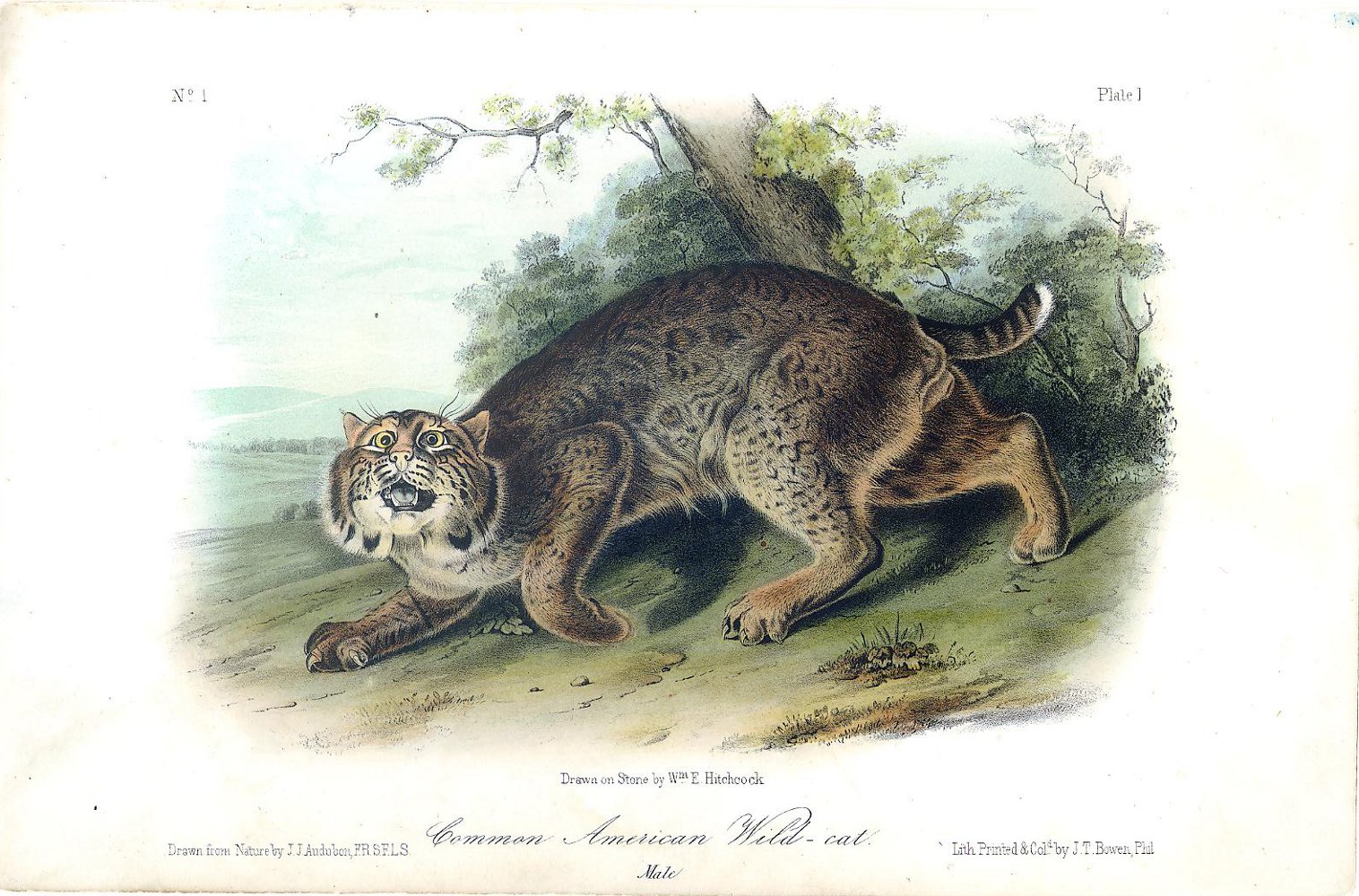
Cats in Art: Common American Wild-Cat (Audubon)

From my continuing weekly Sunday series of cats in art. Currently I'm turning for a couple weeks to John James Audubon. 


Image credit The Philadelphia Print Shop, here, Common American Wild-Cat, John James Audubon.


Why is Audubon important?  Per Wikipedia:

John James Audubon (Jean-Jacques Audubon) (April 26, 1785 – January 27, 1851) was a French-American ornithologist, naturalist, and painter. He was notable for his expansive studies to document all types of American birds and for his detailed illustrations that depicted the birds in their natural habitats. His major work, a color-plate book entitled The Birds of America (1827–1839), is considered one of the finest ornithological works ever completed.

What many folks don't know is that Audubon also set out to depict all North American quadrupeds (primarily four-footed mammals). His three-volume The Viviparous Quadrupeds of North America, published in 1845, contained this illustration.

Although much more famous for his bird art, Audubon managed to do a couple of kitties as well.  The cat above (assumed to be what we call today the Bobcat) looks almost psychotic in its face, and the remainder of the animal seems to be covered with curious scripts and faces.  All in all, it's an odd painting.

I once had the great fortune on a trail run near Monterey, CA, of encountering a juvenile bobcat, and it was one of the most memorable wildlife experiences of my life: grace, power, stealth.  So for me, Audubon's print above is a pretty disquieting rendering of a bobcat.