Saturday, March 16, 2013

Glimpse of a Fox...and Ultrarunning


[sighted in my backyard...photo by Gary]


I love me some critters when I'm out running, and this one was a nice find (please disregard the fact that it is actually a lawn ornament).

Far from being rare, the red fox (Vulpes vulpes) is quite common here in southern Pennsylvania, and I frequently see them in the local farm fields or woodlots near the road.  You can read more at National Geographic.

However, the backcountry is a different story, as foxes are definitely not creatures of the deep woods.  They like edges, boundaries, and mixed terrain, and enjoy a carnivorous diet.  Red foxes are largely nocturnal in habit but are often about during the days.

The mandatory connection to Ultrarunning?  Red foxes are reputedly quite clever.  This is demonstrated by the fact that they always wink at me whenever I see one while out running.


Friday, March 15, 2013

When It's Time to Die...and Ultrarunning

Via Alternet, a very thought-provoking article.

You know, don't you, that you are gonna die.  So will I.  So will everyone we know.  I reason that the only sane way to approach that finality is to try to learn a bit from those who have journeyed closer to that point than I have.


5 Top Regrets People Have At the End of Their Lives | Alternet

Bronnie Ware is an Australian nurse who spent several years working in palliative care, caring for patients in the last 12 weeks of their lives.

She recorded their dying epiphanies in a blog called  Inspiration and Chai, which gathered so much attention that she put her observations into a book called  The Top Five Regrets of the Dying.

Ware writes of the phenomenal clarity of vision that people gain at the end of their lives, and how we might learn from their wisdom. "When questioned about any regrets they had or anything they would do differently," she says, "common themes surfaced again and again."

Here are the top five regrets of the dying, as witnessed by Ware:
 

1. I wish I'd had the courage to live a life true to myself, not the life others expected of me.

"This was the most common regret of all. When people realise that their life is almost over and look back clearly on it, it is easy to see how many dreams have gone unfulfilled. Most people had not honoured even a half of their dreams and had to die knowing that it was due to choices they had made, or not made. Health brings a freedom very few realise, until they no longer have it."

2. I wish I hadn't worked so hard.

"This came from every male patient that I nursed. They missed their children's youth and their partner's companionship. Women also spoke of this regret, but as most were from an older generation, many of the female patients had not been breadwinners. All of the men I nursed deeply regretted spending so much of their lives on the treadmill of a work existence."

3. I wish I'd had the courage to express my feelings.

"Many people suppressed their feelings in order to keep peace with others.

As a result, they settled for a mediocre existence and never became who they were truly capable of becoming. Many developed illnesses relating to the bitterness and resentment they carried as a result."

4. I wish I had stayed in touch with my friends.

"Often they would not truly realise the full benefits of old friends until their dying weeks and it was not always possible to track them down. Many had become so caught up in their own lives that they had let golden friendships slip by over the years. There were many deep regrets about not giving friendships the time and effort that they deserved. Everyone misses their friends when they are dying."

5. I wish that I had let myself be happier.

"This is a surprisingly common one. Many did not realise until the end that happiness is a choice. They had stayed stuck in old patterns and habits. The so-called 'comfort' of familiarity overflowed into their emotions, as well as their physical lives. Fear of change had them pretending to others, and to their selves, that they were content, when deep within, they longed to laugh properly and have silliness in their life again."
 
 
And my dying wish, through the lens of Ultrarunning?  Likely when it's quitting time, I'll wish I would have run more with people.  Not run more, or run less, but to have spent more time with other runners.  Sure, you've got that whole "loneliness of the long-distance runner" thingy going, and it has its appeal.  But the older I get, the more I appreciate and want the companionability of companions.
 
Hey, wait--I could do that now.


Thursday, March 14, 2013

The Weather and Backcountry Gear


I find myself paying an inordinate amount of attention to the weather forecast before I go for a run.  I suppose there's nothing intrinsically wrong with using the technologies that are available to us, to make our lives easier/safer/better etc,

But I wonder how people used to get by...but I know the answer.  They prepared for various contingencies, for the worst conditions that they reasonably could expect to encounter.  And then rode it out.

So when I head into the backcountry, I always, always, check the detailed weather forecast.  You'd be nuts not to.  I carry a bit of extra food, just in case, and have often been very grateful I had it along.  Ditto for water. 

The one item of gear that I always carry in the backcountry--but have never yet used--is a space blanket (a giveaway from some marathon finish line many years back), a candle, and some waterproof matches.  The matches are to light the candle, which may be the only way to get a fire started if conditions are wet.  The fire and the space blanket, of course, are for the contingency of being unable to get out under one's own power, before dark (or getting dangerously chilled).

Anyway, back to the weather and a relevant quotation from The Writer's Almanac, always a good read, from 1 March 2013:

Snow is falling west of here. The mountains have more than a
foot of it. I see the early morning sky dark as night. I won't lis-
ten to the weather report. I'll let the question of snow hang.
Answers only dull the senses. Even answers that are right often
make what they explain uninteresting. In nature the answers
are always changing. Rain to snow, for instance. Nature can
let the mysterious things alone—wet leaves plastered to tree
trunks, the intricate design of fish guts. The way we don't fall
off the earth at night when we look up at the North Star. The
way we know this may not always be so. The way our dizziness
makes us grab the long grass, hanging by our fingertips on the
edge of infinity.
 
"Report from the West" by Tom Hennen, from Darkness Sticks to Everything. © Copper Canyon Press, 2013.

Wednesday, March 13, 2013

Self-Awareness, Humility...and Ultrarunning

Via Mike the Mad Biologist, who directs us to Freddie de Boer...wherein we learn the definition of humility:

…no one is remotely as impressed with you as you are with yourself. No one else mistakes your time for a precious commodity. Self-regard does not make you important, nor does a chronic overestimation of your own value actually make you valuable. You are not the cosmos. Most of the people around you are laughing at you, all the time. They are right to laugh, because you have violated a basic social compact. You believe that what you want and value is more important than what others want and value. In fact, no one thinks much about what you want at all. Some of the best advice you can give: remember that the minute you leave a room, no one is thinking about you.
 
One thing I can say for Ultrarunners: we are the embodiment of humility.  Chalk it up to introversion, withdrawal to spend hours on the trails alone, all that introspection seemingly resulting in heightened self-awareness...whatever, we are a self-effacing lot. 

I have only ever met a couple Ultrarunners who seemed arrogant.  This went way beyond "it's not bragging if you can do it" acknowledgement that we can in fact run vast distances. 

On the other side of the arrogance scale, at my first ultra ever, the Catoctin Trail Races (in Maryland, in 1994, I think) I ran into none otehr than David Horton, who once held the Appalachian Trail thru-running record of 52 days for the 2,181 mile trail, back in 1991).  We were enjoying some post-race food at the same picnic table, and I introduced myself to him, not knowing who he was.

Of course, when I heard his name, I blurted out something like "I've seen your name in print a couple times!", to which David replied: "Yeah, if you pay somebody enough money they'll print anything."


Tuesday, March 12, 2013

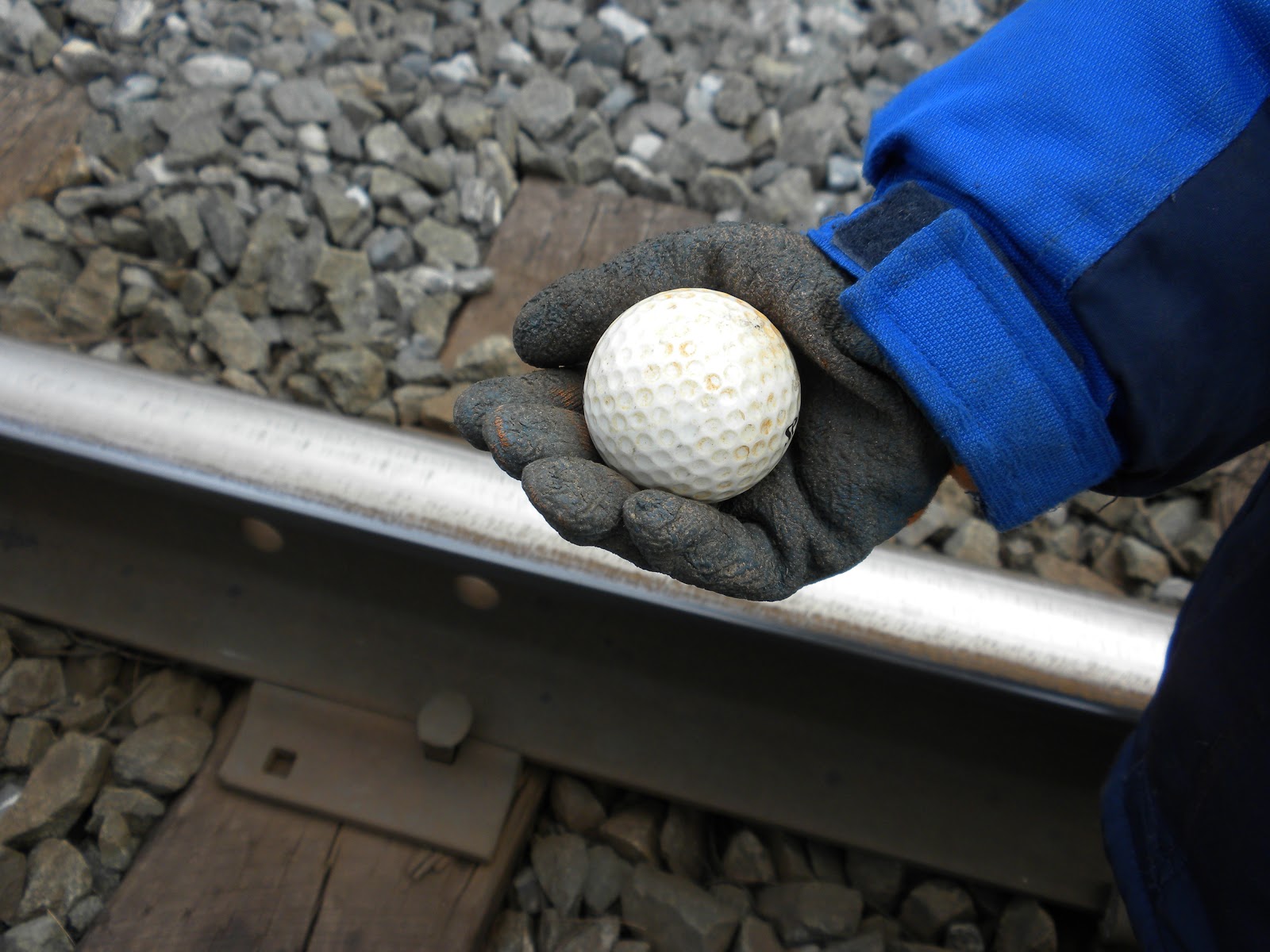
Another Golf Ball...and a Frightening Theory

This one was found by Mister Tristan (the 5-year old human being, not the blog) as we took a short stroll along the Norfolk Southern railroad tracks about half a mile from my home:


As is the case with nearly all of my previous golf-ball-find reporting, this one was not near any homes and certainly nowhere near any golf course.
 
The ubiquitousness of finding golf balls in unlikely places now leads me to consider some formerly outlandish theories.  I'm beginning to suspect that they are alien eggs, prepositioned, awaiting a hidden signal, and when they all hatch en masse there will be hell to pay for mankind.
 
My last installment of golf ball find coverage was here.  And it was less than 2 weeks ago.  The alien apocalypse may be nearer than we think.


Monday, March 11, 2013

Aldo Leopold: A Name You SHOULD Know

[image credit here]

I recently ran across a notification from the Also Leopold Foundation, here, that had established the weekend of 1-3 March 2013 as Aldo Leopold Weekend in Wisconsin.

Well, not being from Wisconsin, I missed it, but the notion is so worthwhile--setting aside a weekend a year to celebrate the life of, and to promote the philosophy of, arguably the most influential ecologist in U.S. history.

I re-read Leopold's classic A Sand County Almanac every year and it's time I did it for 2013 (first I must finish a re-read of an Arthur C. Clark sci-fi classic, Rendezvous With Rama).  But in honor of Leopold and to spread the word, I have a big trail overseers meeting at the end of the month for the Potomac Appalachian Trail Club.  I plan to donate 5 copies as door prizes.

Anyway, here's why the work and writing of Also Leopold are important.  And why, as an ultrarunner and a lover of the backcountry you SHOULD know his work.  The following from 2009 was my first post ever here at Mister Tristan (the blog, not the 5-year old human being).  Enjoy!

++++++++++++++++++

Tuesday, December 22, 2009

A Sand County Almanac

This is my inaugural post for this new blog, Mister Tristan.

Like a recurring pilgrimage, I have just completed my annual re-reading of the ecological classic, "A Sand County Almanac" by Aldo Leopold. My initial reading was prompted some years ago by a college biology professor who recommended it. I became hooked, and for each of the last 30+ years, Leopold, who has been in his grave for 60years, speaks to me and touches me with new and different insights into the nature of things wild and free. I now see Leopold's writings in a way which he never anticipated, but would certainly have approved of--from an ultrarunner's slant.

I continually examine my motives for endurance running (since I spend so much time doing it), and have for some time held the belief that we as a "civilized" species are now so far removed from the moment-by-moment struggle for survival that formerly ruled virtually every waking minute, that we now create for ourselves various means to simulate that intensity. I presume we do this because of some deep-seated need to experience life on the edge, to grab for that gusto and intensity. Thus I run ultras, to physically and mentally go to the edge and see what I can learn there about myself. And I like best to do this running in areas that are preferably wild and remote because there I somehow feel more connected. Simplistic, perhaps, but I suspect not far off the mark for many of us.

The tie-in with Leopold? Here are a couple nuggets: "Physical combat for the means of subsistence was, for unnumbered centuries, an economic fact. When it disappeared as such, a sound instinct led us to preserve it in the form of athletic sports and games...reviving, in play, a drama formerly inherent in daily life." Also, writing about outdoor recreation: "Recreation is valuable in proportion to the degree to which it differs from and contrasts with workaday life."

And on wilderness, Leopold wrote: "Ability to see the cultural value of wilderness boils down, in the last analysis, to a question of intellectual humility. The shallow-minded modern who has lost his rootage in the land assumes that he has already discovered what is important; it is such who prate of empires, political or economic, that will last a thousand years. It is only the scholar who appreciates that all history consists of successive excursions from a single starting point, to which man returns again and again to organize yet another search for a durable scale of values. It is only the scholar who understands why the raw wilderness gives definition and meaning to the human enterprise."

Anyone who values the notions of wilderness, solitude, self-reliance, and of communion with nature that many of us ultrarunners seek, as we use the backcountry as a route to our psyches or souls, should check out Leopold's book. It's commonly available in paperback in bookstores in the Natural History section.


Sunday, March 10, 2013

Cats in Art: Study of a Cat (Valadon)

From my continuing weekly Sunday series of cats in art. I'm using some ideas from the coffee table book, The Cat in Art, by Stefano Zuffi.

This is part 1 of 7 of a multiweek study of the cat art of Suzanne Valadon.  A French painter (1865-1838), she had quite the interesting life (summarized from Wikipedia):

Suzanne Valadon became a circus acrobat at the age of fifteen, but a year later, a fall from a trapeze ended that career. In Paris, she pursued her interest in art, first working as a model for artists, observing and learning their techniques, before becoming a noted painter herself. She modelled for Henri de Toulouse-Lautrec (who gave her painting lessons) and Pierre-Auguste Renoir....Valadon frequented the bars and taverns of Paris along with her fellow painters, and she was Toulouse-Lautrec's subject in his oil painting The Hangover....Valadon painted still lifes, portraits, flowers, and landscapes that are noted for their strong composition and vibrant colors. She was, however, best known for her candid female nudes. A perfectionist, she worked on some of her oil paintings for up to 13 years before showing them....A free spirit, she wore a corsage of carrots, kept a goat at her studio to "eat up her bad drawings", and fed caviar (rather than fish) to her "good Catholic" cats on Fridays....Both an asteroid (6937 Valadon) and a crater on Venus are named in her honor.


Image credit Wikipaintings, Study of a Cat, 1918, Suzanne Valadon, oil on canvas, held in private collection.
 
Zuffi's sparse comment:
 
A late 19th and early 20th century painter, Valadon portrays the cat in a plain, linear style that emphasizes the simple ordinariness of the scene.
 
I really like this cat, just hanging out, not necessarily needing or wanting anything, who appears to be equally ready to be petted, or to get active if the right opportunity presented itself.  This particular feline seems imperturbable and simply happy to be a housecat.  I particularly like the juxtaposition of the arch of the cat's back with the series of arches of the three slats comprising the back of the chair.
 
The bride commented that it was odd that a cat would even deign to be bothered to pose for a painting.
 
But the bottom line is that Valadon's simple, even elegant, painting captures so very well the essence of the cat.
 
By the way, the chair upon which the kitty is perched is very reminiscent of another chair, made famous by Van Gogh.  Or these two chairs, also by Van Gogh.  Except Vincent--in his madness, I suppose--neglected to include any cats in his paintings.


Saturday, March 9, 2013

Where I Run: Norfolk Southern Railroad

The railroad line across the fields from my house is a major north-south regional line linking Harrisburg, PA to Hagerstown, MD and thence to points south.

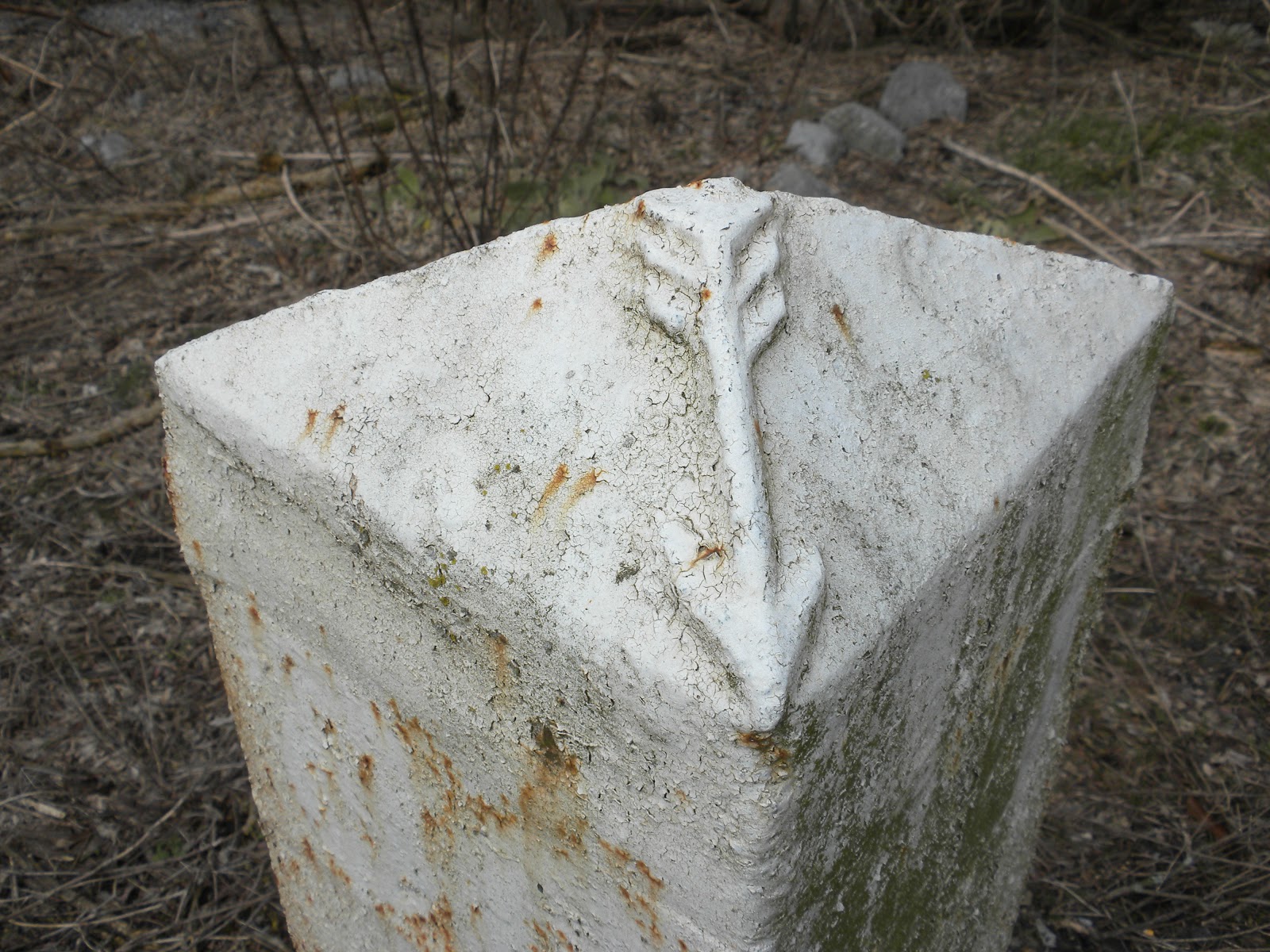
Most lines have mile markers along them.  This one is of note because the newer marker (the 60 sign on a tall post) still has the old marker (the white pyramid) immediately adjacent.

Loaction: from northbound U.S. Rt 11 about 3 miles north of Greencastle, PA, turn right onto the Clay Hill Road.  Go about 1/2 mile; pass under the railroad overpass; immediately turn right onto Friendship Village Road and pull off on the right.  Walk over towards the tracks and the grain elevators beyond.  The mile marker is easily seen, close to the RR overpass and beside the grain elevators.


Closer up for more detail.  The old "60" mark is still faintly visible on the white iron post:


But the real interesting thing to me per the photo below is the detail on the top of the old white marker: an arrow pointing towards the tracks.  The post is made of iron and is about 4' tall.  Undoubtedly the newer post is "better" (i.e., easier to see, longer lasting, cheaper, whatever) but it just doesn't have the charm of the old post.

Back in the day craftspeople did aesthetic things--art, if you will--to enhance otherwise functional objects.  Just because it was pleasing to the eye and soul...or just because.  It's pretty much a lost concept now with the total focus of business strictly on the bottom line.

 
[all photos by Gary]